Should DC Regulate a Spare Bedroom the Same Way It Regulates a 100-Unit Apartment Building?
A policy proposal and petition from the DC Landlord Association*
If you rent a bedroom in the home where you live, you may share a kitchen, bathroom, or front door with your tenant. If you rent a separate English basement apartment, you may share a water meter while maintaining two distinct households. If you operate 100 apartments, you’re responsible for maintenance, billing, and emergency response across an entire operation.
Each tenant deserves safe housing, clear rental terms, and a way to resolve problems. The District can uphold those protections while tailoring paperwork, inspections, and reporting to the property and the size of the rental operation.
The DC Landlord Association is asking DC Landlords to weigh in. Which requirements make sense for your property? Where are you filing the same information twice, getting conflicting guidance, or struggling to find the right form? What should the District ask of a homeowner renting one room, an owner with four units, or a company managing 100 homes?
DC already recognizes different types of rentals
The District has distinct licensing categories for one-family rentals, two-family rentals, apartments, and rooming houses. DC law also provides a conditional exemption from certain rent-control provisions for qualifying owners with four or fewer rental units. And the Tenant Opportunity to Purchase Act has a separate provision for single-family accommodations. Those distinctions give the Council a starting point for making licensing, registration, and other compliance procedures easier to navigate.
Six Proposed Tiers for DC Rental Housing
When a homeowner and tenant share a kitchen, bathroom, or hallway, both may have to pass through the same space every day while a serious safety dispute is pending. A tenant in a separate basement apartment may share an entrance with the owner but ordinarily has a private dwelling. In a large apartment building, management may have staff, repair records, and other resources to address a problem before seeking eviction. DC’s procedures should reflect those differences.
The DC Landlord Association proposes a faster court process for serious safety cases in shared homes, with progressively more documentation and pre-filing steps for larger rental operations in routine cases. These are proposed reforms. DC’s current eviction statute governs when a landlord can recover possession and what notices are required.
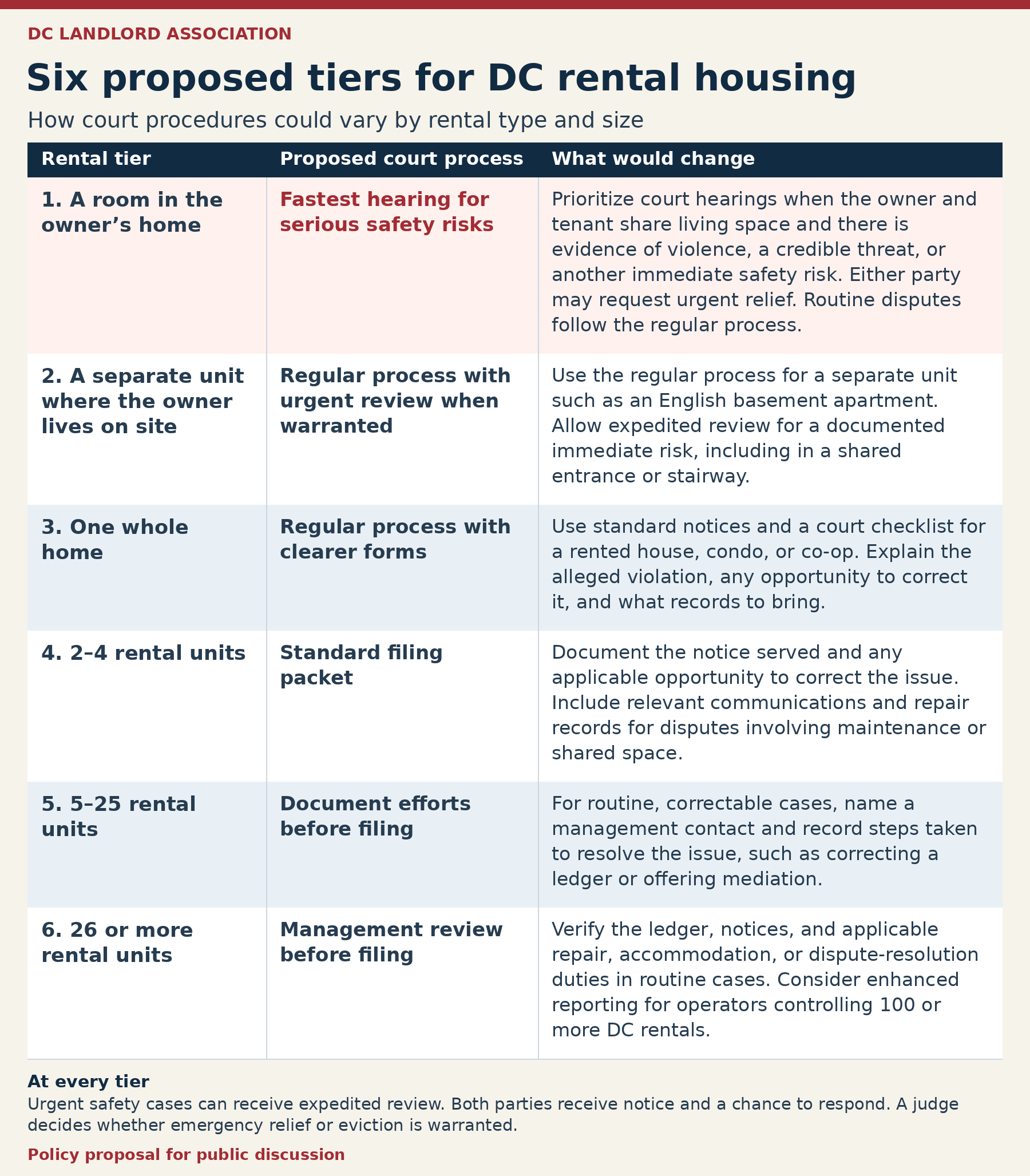
A faster hearing should still be a fair hearing. Both parties should receive notice and a meaningful opportunity to respond. A judge should decide whether emergency relief or possession is warranted. An expedited track would never authorize a lockout, a utility shutoff, or removal without lawful process. A serious, immediate safety threat should qualify for urgent review at any tier. Shared-home cases deserve the earliest available hearing because the people involved may still be living under the same roof.
DC landlords, weigh in. Have you dealt with a safety issue in a home you shared with a tenant? What would a faster hearing have helped resolve? If you operate a larger property, what steps should management take before filing a routine case? Sign the petition or share your experience to help shape the proposal.
These tiers are proposed for public discussion. We want landlords to tell us whether 4, 25, and 100 units are sensible thresholds and where their experience points to a better approach.
What else should the District consider?
Count the building and the portfolio. Safety inspections should reflect conditions at each property. Management and reporting duties should also reflect the total number of DC rentals under common ownership or control. An operator with 100 houses spread across several LLCs still has a 100-home operation.
Account for rentals that need their own rules. Rooming houses and co-living properties with separately leased bedrooms raise distinct questions about occupancy, shared facilities, and emergency exits. Subsidized and supportive housing should keep applicable program protections while agencies coordinate overlapping inspections and reporting. Short-term lodging has its own licensing framework.
Prioritize hazards and repeated violations. A three-unit building with recurring heat outages can need more oversight than a well-maintained 30-unit building. Address serious hazards promptly at every tier and give owners a clear opportunity to correct minor paperwork errors.
Give landlords and tenants one place to find the rules. A property lookup should show the applicable license, registration steps, inspection requirements, and notices. Agencies should provide a written answer when there’s uncertainty about whether a space is a room rental, a separate dwelling, or a rooming house.
Create a one-stop rental license/ registration. DC should give landlords one button to start the inspection, licensing, and rental registration process. The owner would enter the property address and rental type once, upload documents in one place, and schedule any required inspection through the same portal. The portal would route the information to the appropriate agencies and show the owner what’s complete, what needs correction, and what comes next. The rental process should be clear and simplified.
Keep core tenant protections in place. Preserve applicable safety, habitability, fair housing, privacy, notice, and lawful eviction protections. A model shared-home agreement can spell out how the owner and tenant use the kitchen or living room while respecting the tenant’s private space.
The Fair Housing Practices Amendment Act of 2026 offers a timely example. Starting January 1, 2027, landlords and their billing vendors cannot separately charge tenants for utilities attributable to common areas or vacant units. A homeowner with one shared water meter could use plain-language guidance and a sample bill. A large operator can document how its billing vendor applies the rule across multiple properties.
Sign the Petition for Rental Rules That Fit DC’s Housing
To the Council of the District of Columbia and the Mayor of Washington, DC
We, the undersigned DC landlords and housing providers, ask the District to hold a public roundtable and develop a tiered approach to residential rental compliance. The framework should account for whether the owner (1 - 2 Family) lives on site, whether the tenant shares living space with the owner, how many units are in the building, and how many DC rentals the ownership group controls.
We ask the District to simplify licensing and registration, publish standard forms and property-specific checklists, coordinate overlapping inspections, and set reporting requirements that reflect the size of the operation. We support preserving applicable tenant protections and prioritizing serious hazards and repeat violations at every tier.
We ask the Council to hear directly from small landlords, tenants, property managers, and agency staff before setting thresholds or changing requirements.
DC Landlords, tell us what you’re seeing
You can support the petition, suggest changes to the proposal, or do both. Tell us about one rule or process you’ve dealt with, what happened, and what would have made it work better.